Automotive Upholstery: Paper Solutions for Car Seat Cover Manufacturing
- SATVA BY JR
- Feb 2
- 11 min read

Introduction: The Hidden Engineering Behind Premium Car Seat Covers
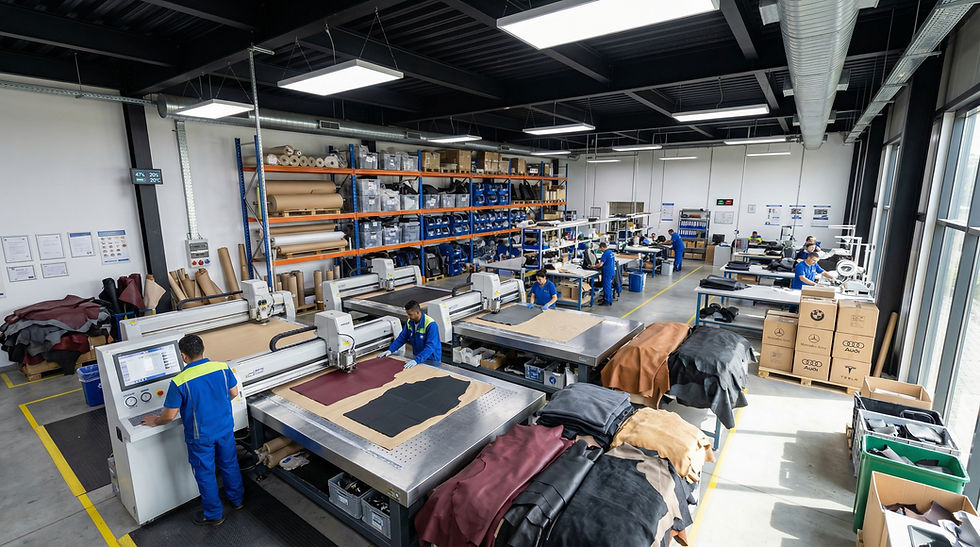
The automotive upholstery industry operates under standards dramatically different from apparel manufacturing. When you sink into a premium car seat, you're experiencing the result of precision engineering, specialized materials, and manufacturing processes optimized for durability, safety, and aesthetic excellence. Yet few consumers realize that beneath the leather or fabric covering lies a sophisticated system of pattern cutting, padding, stitching, and assembly—each step dependent on industrial-grade materials.
Car seat cover manufacturing demands materials engineered specifically for automotive applications: extreme durability requirements, precision cutting standards, and consistency across thousands of identical units. The paper systems supporting these operations must withstand pressures, temperatures, and usage patterns fundamentally different from standard garment production.
This comprehensive guide explores specialized paper solutions engineered for automotive upholstery manufacturing, examining the unique requirements that distinguish car seat cover production from apparel operations, and how advanced perforated underlayment systems deliver the precision and reliability automotive manufacturers demand.
Understanding Automotive Upholstery Manufacturing
The Complexity of Car Seat Cover Production
Car seat covers represent one of the most complex textile products manufactured today. Unlike simple apparel, seat covers must integrate multiple material systems, accommodate complex 3D shaping, and maintain precision across hundreds of pattern pieces per vehicle.
Typical Car Seat Assembly Components:
Outer decorative cover fabric (leather, microfiber, or specialty textile)
Backing support layer (provides structure and durability)
Padding and foam integration (comfort and impact absorption)
Piping and trim elements (aesthetic and functional)
Seaming and stitching assembly (strength and water resistance)
Fastening systems (attachment to vehicle base)
Pattern Count Per Seat:
Average 25-40 individual pattern pieces per seat cover
Premium seats: 50+ unique patterns
Full vehicle coverage: 200-500+ pattern pieces total
Multiple sizes/configurations: Different seat styles, size classes, customizations
Manufacturing Scale & Volume Requirements
Automotive manufacturers operate at production volumes fundamentally different from apparel:
Daily Production Volumes:
Mid-size automotive supplier: 500-2,000 seat covers daily
Tier-1 supplier: 5,000-15,000+ seat covers daily
Major OEM facilities: 20,000-50,000+ daily
Global capacity: Multiple facilities producing simultaneously
Annual Production Impact:
Single major manufacturer: 2-10 million seat covers annually
This translates to 50-500+ million pattern pieces cut annually
Precision requirements: Zero tolerance for quality variation
Consistency demands: Identical cuts across years of production
Cutting Room Operations:
24-hour operations (3-shift manufacturing standard)
Multiple CNC automated cutting machines operating simultaneously
Continuous paper system changeover requirements
Minimal downtime tolerance (production on tight schedules)
Automotive Industry Standards & Requirements
OEM (Original Equipment Manufacturer) Specifications
Major automotive manufacturers impose rigorous specifications on suppliers:
Precision Requirements:
Cut tolerance: ±1-2mm (automotive standard, much tighter than apparel)
Pattern repeatability: 99.8%+ consistency required
Seam allowances: Exact specifications, zero deviation
Pattern nesting efficiency: Minimize waste (cost critical at scale)
First-quality rate: 98%+ parts acceptable (2% waste maximum)
Material Performance Standards:
Seam strength: Must withstand 200+ pounds pulling force
Durability: 10+ year automotive lifecycle (vs. 1-2 years apparel)
Colorfastness: Maintain appearance through sun, heat, chemicals
Fire resistance: Meet automotive safety standards
Cleaning/maintenance: Survive professional cleaning processes
Cutting Accuracy Standards:
Blade sharpness: Precise edge cutting (no pulling or distortion)
Pressure uniformity: Even cutting force across entire pattern
No fabric distortion during cutting process
Clean separation of pattern pieces
No loose fibers or fabric damage
Why Perforated Paper for Car Seat Manufacturing?
The vacuum-based cutting systems supporting automotive production require precision perforated paper systems engineered specifically for the demands:
Vacuum Seal Precision: Perforated paper creates the vacuum seal that holds multi-ply material stacks stationary during cutting. Automotive applications use thicker, heavier materials than apparel—sometimes 3-5 fabric layers stacked together (decorative fabric + backing + padding integration).
Pressure Distribution: Heavy multi-ply stacks require uniform pressure distribution across entire cutting area. Perforated paper perforation pattern must be perfectly uniform to prevent pressure variations that cause cutting inaccuracy.
Extended Run Capability: Automotive production cuts thousands of identical patterns from single paper installation. Paper must maintain vacuum seal integrity through 100+ hour continuous operation without degradation.
Durability Under Load: Automotive fabrics are heavier, stiffer materials than apparel textiles. Cutting forces are greater, requiring heavy-duty perforated paper rated for industrial automotive use.
Perforated Paper Specifications for Automotive Manufacturing
Why Industrial-Grade Perforated Paper Matters
Standard perforated paper designed for apparel manufacturing is insufficient for automotive applications. The heavier materials, extended production runs, and precision requirements demand purpose-engineered solutions.
SATVAJR Industrial-Grade Perforated Paper Specifications:
Material Composition:
Virgin kraft paper (not recycled—purity critical)
100 GSM professional-grade weight
Brown kraft standard (professional appearance)
Uniform fiber structure ensuring consistent perforation
Perforation Engineering:
Hole diameter: 5mm standard (optimized for automotive vacuum systems)
Hole spacing: 1-2 inch uniform pattern (ensures even pressure distribution)
Perforation precision: ±0.1mm tolerance (critical consistency)
Vacuum efficiency: 70-80% airflow (measured under standard pressure)
Durability Specifications:
Tear resistance: Withstands 200+ pound pulling force
Puncture resistance: Engineered for heavy-duty materials
Moisture stability: Maintains perforation integrity in 40-50% humidity
Longevity: 200+ hour continuous use before replacement
Flatness retention: Does not curl or warp under vacuum pressure
Dimensional Precision:
Width tolerance: ±1mm (critical for precise equipment fit)
Thickness consistency: ±0.05mm (ensures uniform vacuum pressure)
Roll diameter: Consistent across entire roll length
Flatness: Zero curl or edge waviness
Available Widths for Automotive:
48-inch: Smaller components, flexible pattern nesting
62-inch: Standard automotive cutting tables
64-inch: OEM specification standard
72-inch: Extended capacity for complex patterns
78-inch: Large patterns and high-volume nesting
80-inch: Maximum width for largest automotive components
Pricing:
All widths: ₹3,295 per roll (20KG standard)
Consistent pricing across specifications (value pricing)
Volume discounts available (100+ roll orders)
Direct manufacturer pricing (no middleman markup)
Understanding Paper Weight (GSM) for Automotive
Why 100 GSM for Automotive?
100 GSM (grams per square meter) represents the optimal specification for automotive applications:
Strength Requirements:
100 GSM provides sufficient structural integrity for heavy multi-ply stacks
Withstands 200+ pounds pulling force without tearing
Resists puncture from sharp material edges
Maintains flatness under sustained vacuum pressure
Handles 200+ hour continuous operation without degradation
Lighter Alternatives Insufficient:
80 GSM marginal for heavy automotive fabrics
Risks perforation tearing during extended production
Insufficient structural integrity for multi-ply stacks
Not recommended for automotive applications
Heavier Alternatives Unnecessary:
120+ GSM provides no performance advantage for automotive
Increases cost without benefit (diminishing returns)
May reduce vacuum efficiency (thicker material restricts airflow)
100 GSM represents optimal balance
Virgin vs. Recycled Kraft Paper for Automotive
Virgin Kraft Paper (SATVAJR Standard):
Advantages: Consistent purity, uniform fiber structure, precise perforation capability, reliable performance
Disadvantages: Higher cost vs. recycled
Recommendation: Required for automotive specifications
Why: OEM suppliers demand virgin material for quality assurance
Recycled Kraft Paper:
Advantages: Lower cost, environmentally conscious
Disadvantages: Inconsistent fiber quality, perforation variability, reduced reliability
Not Recommended: For automotive precision manufacturing
Why: Inconsistency risks product quality and customer satisfaction
SATVAJR Policy: Automotive customers receive virgin kraft only—no recycled material substitution.
Automotive Cutting Room Setup & Optimization
System Architecture for Automotive Production
Automotive cutting rooms operate with more sophisticated systems than standard apparel operations:
Automated CNC Cutting Machines for Automotive:
Equipment Type: Large-format flatbed CNC cutters (laser or knife blade)
Cutting Table Dimensions: 60-100 inches wide, 120-180 inches long
Vacuum System: 250-350 mmbar pressure (higher than apparel standard)
Material Stack Capacity: 5-8 layers simultaneously (vs. 2-3 for apparel)
Precision Class: ±1-2mm (vs. ±3-5mm apparel standard)
Multi-Layer Cutting Advantages:
Cuts multiple identical patterns simultaneously (efficiency)
5-8 layers = 5-8 times the production speed
Reduces per-unit cutting time dramatically
Improves overall manufacturing economics
Installation Best Practices for Automotive Operations
Pre-Installation Preparation:
Verify equipment specifications and cutting table dimensions
Confirm OEM requirement documentation (specific standards)
Clean cutting table thoroughly (remove contaminants)
Test vacuum system (verify 250-350 mmbar target pressure)
Inspect blade/laser condition and alignment
Perforated Underlay Installation:
Unroll perforated paper on clean, flat surface
Verify perforation pattern uniformity (critical for automotive)
Confirm zero tears, punctures, or damage
Position on cutting table with perforations facing upward
Align perforations perfectly with vacuum ports
Extend paper to cover entire cutting area with 2-inch overhang
Secure edges with automotive-grade tape (not standard tape)
Verify absolutely flat (no wrinkles, no air pockets)
Test vacuum seal (activate system, confirm even suction)
Vacuum Verification:
Pressure gauge should read 250-350 mmbar continuously
No audible air leaks (listen for hissing)
Entire paper surface should feel even suction
Place test fabric—should remain absolutely stationary when vacuum activated
Multi-Layer Stack Configuration:
Perforated underlay (bottom, directly on cutting table)
Poly overlay film (optional for automotive, sometimes used)
First fabric layer (decorative cover material)
Interlayer materials (backing, padding as specified)
Additional fabric layers (up to 5-8 total for multi-layer cutting)
Final protective layer (top)
Operating Parameters for Automotive Materials
Pressure Settings by Material Type:
Leather: 300-350 mmbar (heavy, dense material)
Microfiber/Synthetic: 280-320 mmbar (moderate weight)
Fabric Blend with Backing: 320-350 mmbar (multiple layers)
Specialty Automotive Textiles: 250-300 mmbar (varies by specification)
Blade Speed for Automotive:
Light materials: 60-100 mm/second
Heavy materials: 40-80 mm/second
Multi-layer stacks: 30-60 mm/second (slower = better precision)
OEM tolerance: Follow exact specifications (no deviation)
Production Schedule for Paper Replacement:
24-hour operations: Replace perforated paper daily
12-hour operations: Replace every 2 days
Standard 8-hour shifts: Replace weekly
Trigger replacement: When vacuum pressure drops >10 mmbar or any suction irregularity detected
Automotive-Specific Applications
Car Seat Cover Manufacturing
Car seat covers represent the primary automotive upholstery application. The complexity and precision demands exemplify why specialized perforated paper matters:
Seat Cover Manufacturing Process:
Pattern Design: CAD software generates 25-40+ unique patterns per seat type
Material Selection: Leather, microfiber, or specialty automotive textiles selected
Cutting: Precision CNC cutting of decorative cover, backing layers, padding
Seaming: Pieces sewn together with automotive-spec thread and stitching
Assembly: Integration of padding, piping, trim elements
Quality Control: 100% inspection (zero defects required)
Fastening: Attachment systems for vehicle integration
Final Assembly: Installation into vehicle on OEM production line
Precision Requirements:
±1mm cutting tolerance (any variation risks fit issues)
99.8%+ first-quality rate (vehicle assembly cannot wait for replacements)
Perfect pattern nesting (minimize waste, maximize efficiency)
Consistent material handling (no stretching, distortion, or damage)
Dashboard & Interior Trim Applications
Automotive interiors extend beyond seats to dashboard panels, door trim, and interior components:
Dashboard Panel Manufacturing:
Rigid or semi-rigid backing materials (plastic composites with fabric covering)
Precision pattern cutting (exposed surfaces—visible quality critical)
Exact panel fit (tolerance ±1mm critical)
Heat resistance (dashboard temperatures reach 140°F+)
Durability (10+ year automotive lifecycle)
Interior Trim Components:
Headrest covers
Armrest padding and covering
Door panel accents
Center console components
Pillar covers
All applications require same precision, durability, and quality standards as seat covers.
Specialty Automotive Applications
Floor Mat Manufacturing:
Heavy-duty backing materials
Durable textile facing
Moisture resistance
Long-term durability requirements
Cargo Cover Applications:
Extended durability (constantly flexing under cargo)
Moisture and stain resistance
Precise fit requirements
UV resistance (exposed to sunlight)
Custom Interior Modifications:
Specialty vehicles (luxury, performance, custom builds)
Higher precision requirements (visible quality paramount)
Extended durability standards
Luxury finish expectations
Troubleshooting Automotive Cutting Issues
Issue 1: Inaccurate Cuts in Multi-Layer Stacks
Symptoms:
Layer-to-layer cutting variation (each layer cuts differently)
Pieces don't align properly during assembly
OEM rejects parts for tolerance violations
Scrap rate exceeds 2% threshold
Root Causes:
Uneven vacuum pressure (multi-layer stacks require perfect uniformity)
Worn perforated paper (vacuum seal compromised)
Blade/laser misalignment
Insufficient pressure for material weight
Perforations blocked or damaged
Solutions:
Verify vacuum uniformity (test pressure at multiple points across cutting table)
Replace perforated underlay (multi-layer work degrades paper faster)
Check blade alignment (verify blade/laser position matches programming)
Increase vacuum pressure (heavy multi-layer stacks often require 350 mmbar)
Clean perforations (check for material debris blocking holes)
Issue 2: Leather Distortion & Damage During Cutting
Symptoms:
Leather surface shows pressure marks or distortion
Cut edges appear rough or pulled (not clean)
Visible damage to valuable leather material
High scrap rate and cost impact
Root Causes:
Excessive vacuum pressure for leather (damages material)
Blade dull or misaligned
Paper perforation pattern creating pressure hot-spots
Poly overlay film dirty or damaged
Cutting speed too fast for leather type
Solutions:
Reduce vacuum pressure (leather typically requires 280-300 mmbar, not 350+)
Replace blade (dull blade tears rather than cuts clean)
Install new perforated paper (ensure uniform perforation pattern)
Clean or replace poly film (damaged film creates uneven pressure)
Reduce cutting speed (slower cutting prevents leather damage)
Issue 3: Inconsistent Vacuum Through Extended Production
Symptoms:
Early cuts precise and clean
Later cuts in same production run become loose/inaccurate
Vacuum pressure gradually declining during 20+ hour run
Quality deteriorates as production continues
Root Causes:
Perforated paper perforation holes becoming blocked (fabric lint buildup)
Vacuum system not designed for extended automotive production
Poly film degradation during heavy use
Minor air leaks developing through extended operation
Debris accumulation in vacuum system
Solutions:
Schedule paper replacement every 100-150 hours (prevent degradation)
Implement mid-shift paper changes (maintain consistent quality)
Clean vacuum system regularly (prevent blockage buildup)
Replace poly overlay film frequently (every 48 hours for heavy use)
Maintain equipment vacuum pump (verify sufficient system capacity)
Best Practices for Automotive Cutting Room Operations
Quality Management
Daily Operations Checklist:
☐ Verify OEM specification documentation available
☐ Test vacuum system (confirm 250-350 mmbar pressure)
☐ Inspect perforated paper (no damage, proper installation)
☐ Run test cuts on scrap material (verify precision)
☐ Document all cuts and quality metrics
☐ Monitor first-quality rate (maintain 98%+ standard)
Weekly Maintenance:
☐ Replace perforated underlay paper
☐ Clean vacuum system and ports
☐ Replace poly overlay film (if used)
☐ Inspect blade/laser condition
☐ Calibrate equipment (verify precision)
☐ Review scrap rate and quality data
Monthly Reviews:
☐ Analyze first-quality rate trends
☐ Review OEM feedback and complaints
☐ Plan inventory for next month
☐ Assess equipment maintenance needs
☐ Review operator training/certification
Inventory Management for Automotive
Stock Level Determination:
Daily consumption: Calculate average rolls used per day
Safety stock: Maintain 2-week supply (prevents production halts)
Lead time: Account for supplier delivery schedule
Seasonal variation: Adjust for production volume changes
Emergency stock: Extra rolls for unexpected heavy production
Reordering System:
Automatic reorder at 1-week supply remaining
Multiple widths maintained (accommodate various patterns)
Direct supplier relationship (ensure priority service)
Backup supplier identified (for emergency situations)
Storage Conditions:
Temperature: 15-25°C (room temperature)
Humidity: 40-50% (critical for vacuum efficiency)
Location: Climate-controlled warehouse
Organization: Separate by width, creation date
Training & Certification
Operator Certification:
Comprehensive training on equipment operation
OEM specification understanding (critical)
Vacuum system operation and troubleshooting
Quality standards and inspection procedures
Paper installation and replacement procedures
Certification renewal: Annual verification
Supervisor Competency:
Advanced troubleshooting skills
OEM requirement interpretation
Quality metrics management
Production scheduling optimization
Equipment maintenance oversight
Team training and certification
SATVAJR Automotive Solutions
Complete Product Range for Automotive Manufacturers
Industrial-Grade Perforated Underlay Paper:
Widths: 48", 62", 64", 72", 78", 80"
Specification: 100 GSM virgin kraft
Perforation: 5mm holes, 1-2 inch spacing
Durability: 200+ hour continuous operation
Quality: OEM-approved specifications
Price: ₹3,295 per roll (consistent across widths)
Link: https://www.satvajr.com/category/underlay-paper-perforated-underlay-paper
Optional: Poly Overlay Film (for specialized applications):
Widths: 80", 92", 100"
Specification: 20 micron HDPE
Properties: Anti-static, heat-resistant
Price: ₹3,599 per roll
Why SATVAJR for Automotive
OEM Compliance:
Virgin kraft material (meets automotive standards)
Precise specifications (±tolerance verified)
Consistent quality (batch-to-batch repeatability)
Documentation available (for supplier audits)
Performance Reliability:
200+ hour proven operation under automotive loads
Multi-layer stack capability verified
Vacuum efficiency tested (70-80% airflow confirmed)
Extended run capability demonstrated
Supplier Relationship:
Direct manufacturer (quality control in-house)
Priority service for automotive customers
Technical support available
Bulk pricing for high-volume operations
Flexible delivery schedules
Ordering for Automotive Operations
SATVAJR Contact Information:
Phone: +91 97 2345 0013
WhatsApp: Fast consultation for automotive specifications
Email: contactus@satvajr.com
Address: Ahmedabad, Gujarat, India-382405
Information Needed:
Equipment specifications (cutting table dimensions)
Required widths (specific for your patterns)
Monthly volume (for inventory planning)
OEM specifications (copy of requirements)
Delivery location and frequency
Any custom specifications needed
Bulk Ordering Benefits:
Volume discounts available (100+ roll orders)
Priority inventory allocation
Flexible payment terms
Technical consultation included
Delivery coordination for manufacturing schedules
Conclusion: Precision Paper for Automotive Excellence
Automotive upholstery manufacturing represents the highest standards of precision textile cutting. The durability requirements, safety standards, and OEM specifications demand specialized materials engineered specifically for automotive applications.
SATVAJR's industrial-grade perforated paper delivers the precision, consistency, and reliability that automotive manufacturers demand. Every specification—from virgin kraft material to 5mm perforation engineering—is optimized for the unique demands of car seat cover manufacturing and automotive interior production.
Your commitment to delivering premium automotive interiors deserves material support matching that excellence. Specialized perforated paper isn't an afterthought—it's the foundation enabling the precision, efficiency, and quality that automotive manufacturers require.
Choose SATVAJR for Automotive-Grade Perforated Paper Solutions:
Industrial Precision: Purpose-engineered for automotive applications
OEM Compliance: Meets automotive manufacturer specifications
Proven Performance: Tested in high-volume automotive production
Consistent Quality: Batch-to-batch reliability
Technical Support: Expert guidance for optimal setup
Explore SATVAJR Automotive Solutions:
Perforated Underlay Paper: https://www.satvajr.com/category/underlay-paper-perforated-underlay-paper
Contact for Automotive Specifications: +91 97 2345 0013
Professional-Grade Paper Solutions. Automotive Manufacturing Excellence. SATVAJR Precision.
Comments